
Concept homepage · not a production STORE property
AI Infrastructure That Humanity Can Govern.
STORE is a global network of independently operated data centers, coordinated by transparent pricing and governed by people instead of a single corporation.
Above one-third: forbidden. A violation is a type error - the forbidden state cannot be written.
Is this actually built? Yes.
A quick view of the live network today.
Santa Clara, Ashburn, Toronto, Melbourne, Sydney.
Live compute capacity across those 5 data centers.
12,000 TB of live storage capacity.
Independent people, not one company, vote on network rules.
Governors are spread across the world, not concentrated in one place.
Consecutive days of constitutional governance with zero violations.
Start here
STORE in 30 Seconds
Six ideas. One network.
 Swipe →
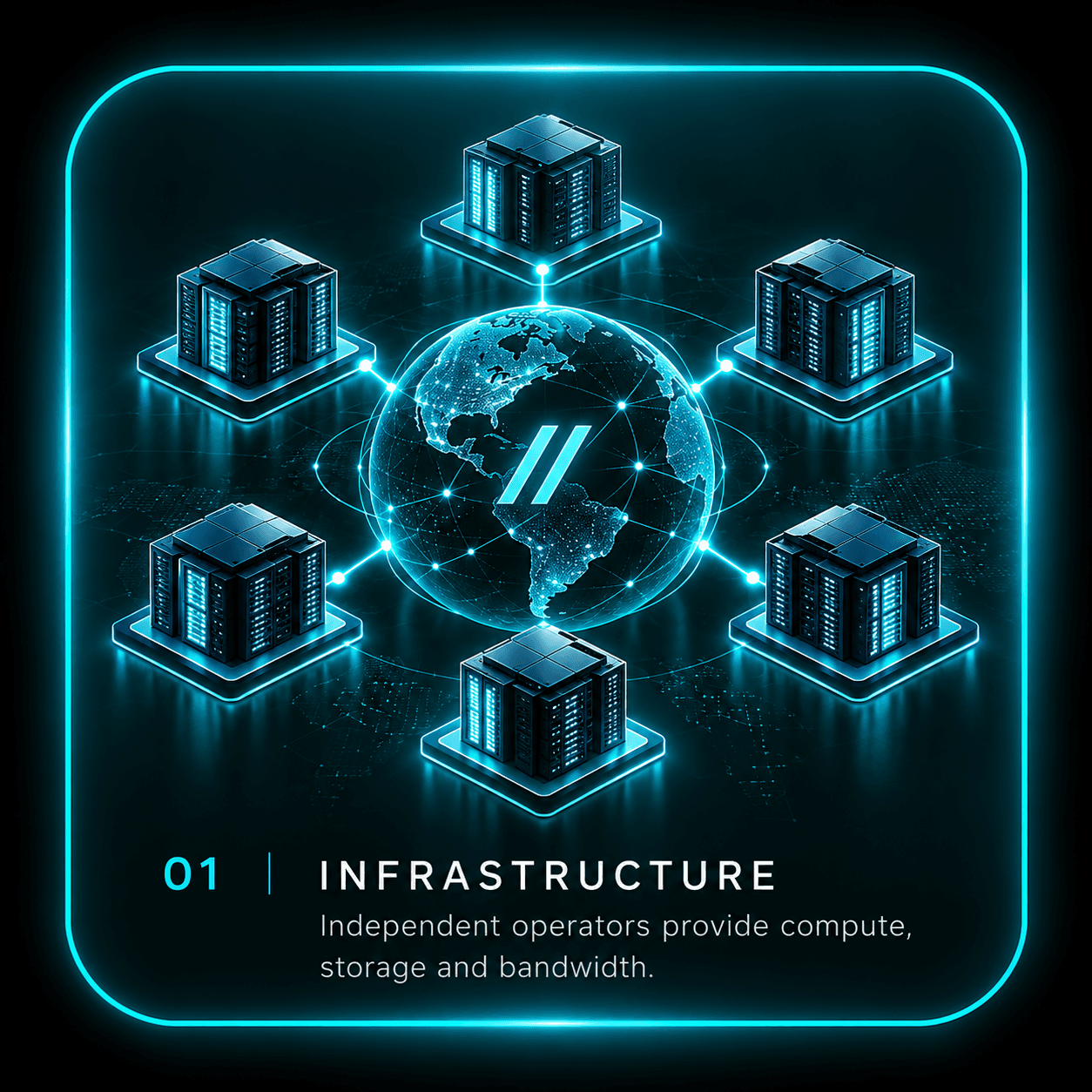
01 · STORE
AI infrastructure humanity can govern.
STORE brings compute, storage, AI, payments, and governance into one network built from independent infrastructure.
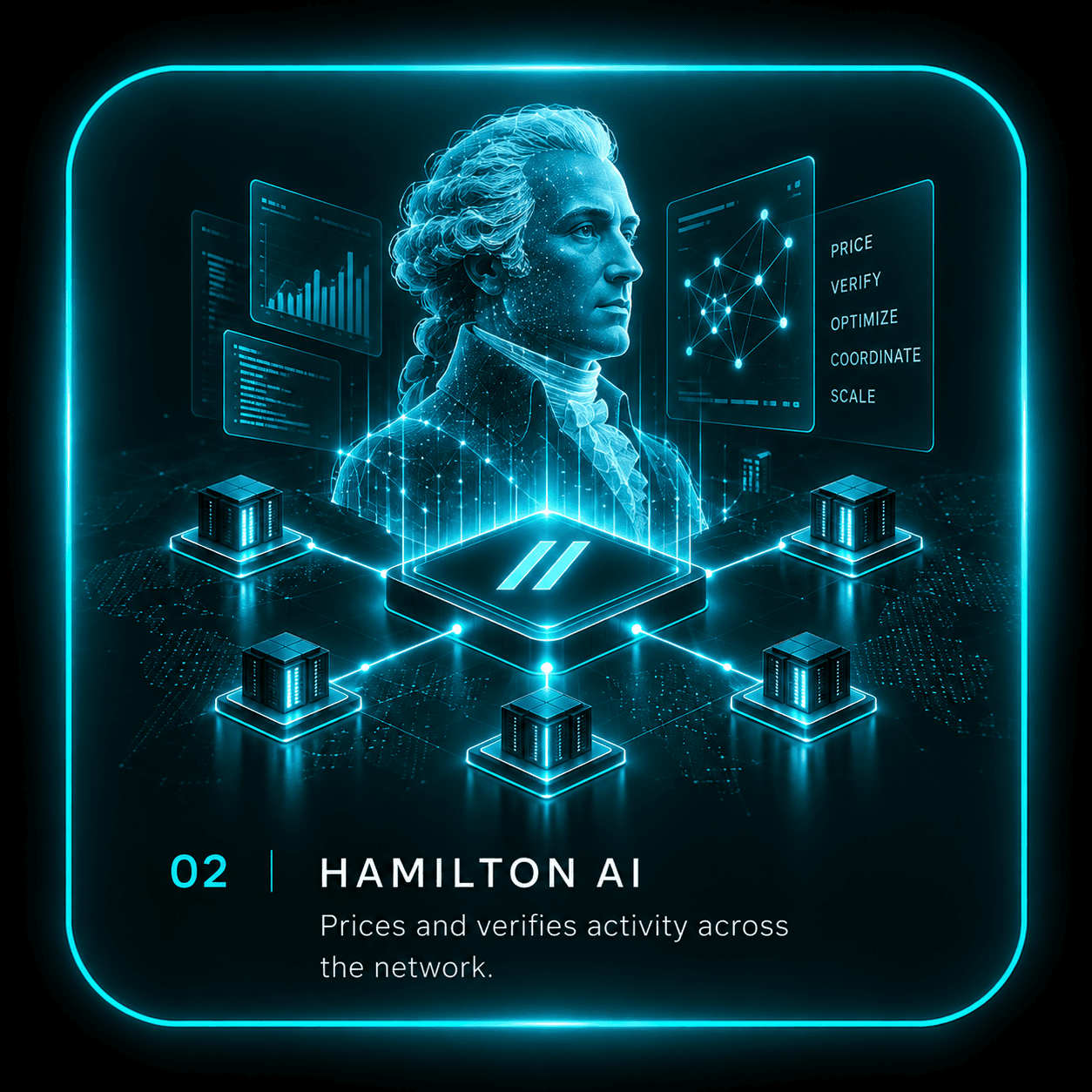
02 · Hamilton AI
The intelligence layer.
Hamilton AI prices and verifies activity across the network, turning infrastructure and AI activity into measurable economic events.
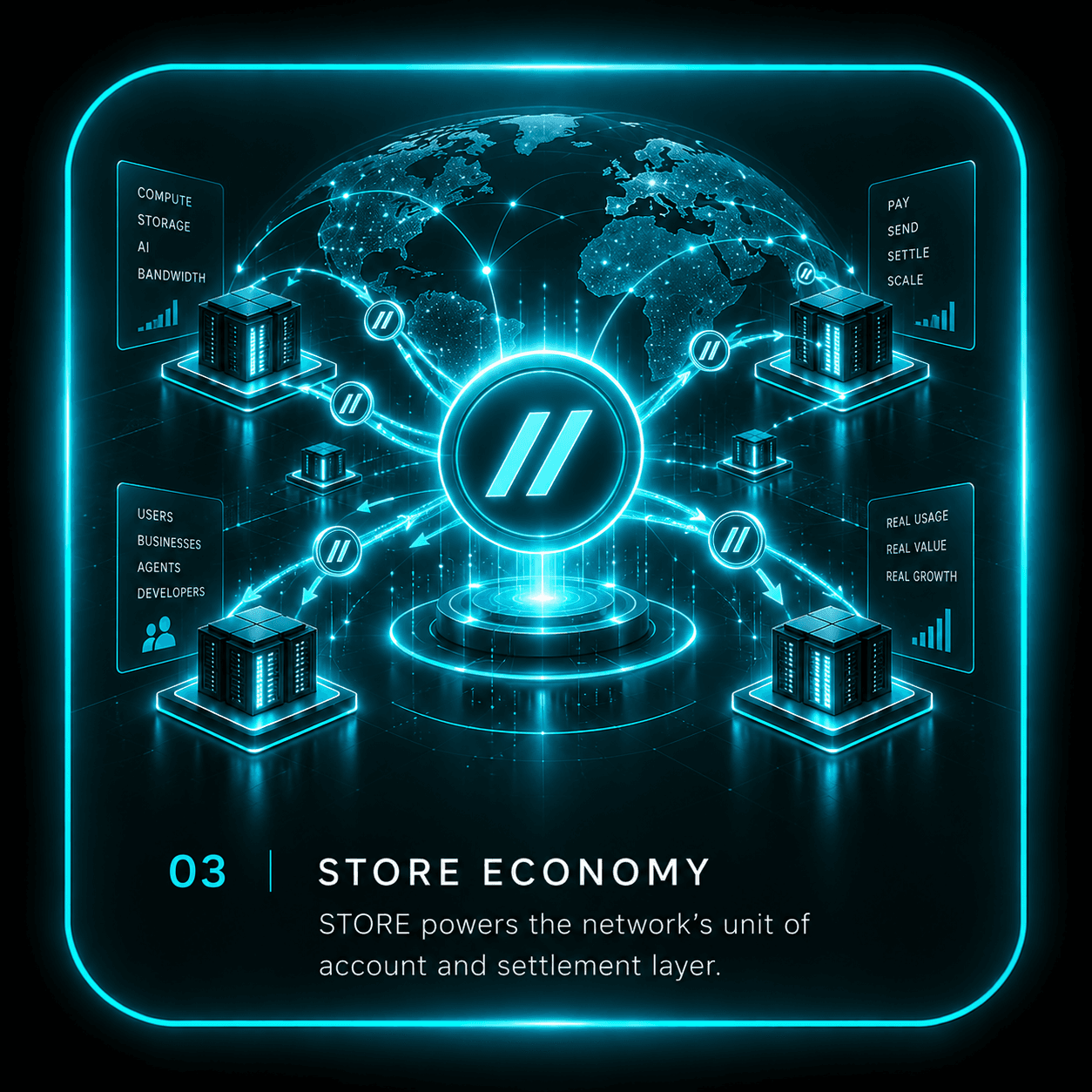
03 · STORE Economy
One token. Multiple jobs.
STORE acts as the network's unit of account and settlement layer while supporting rewards and governance participation.
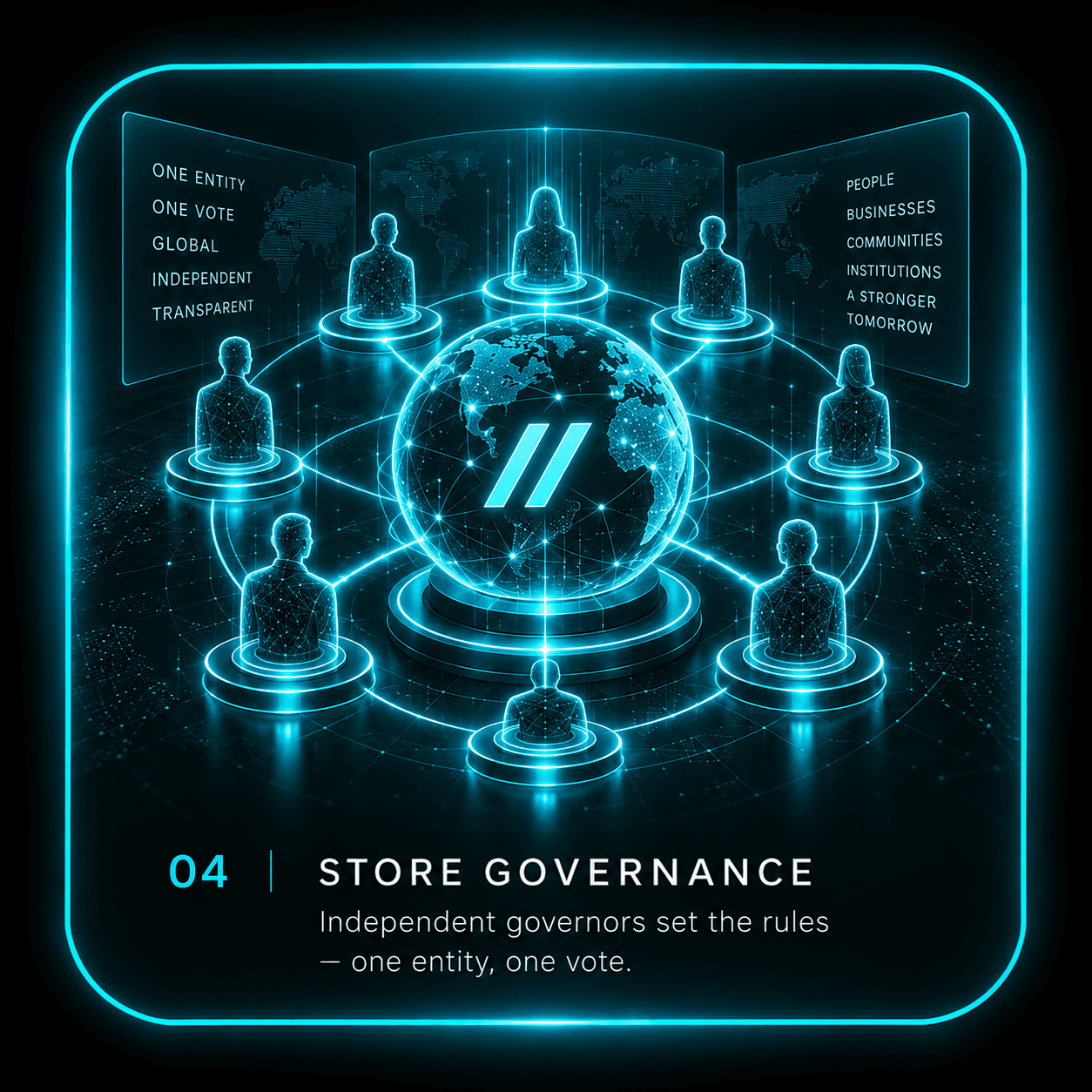
04 · Governance
No one gets absolute control.
Governors participate through STORE's governance architecture, with constitutional safeguards designed to prevent any single governor from controlling the network.

05 · Proof
Every action leaves evidence.
Verifiable receipts create an auditable record of network activity so actions can be checked rather than simply trusted.
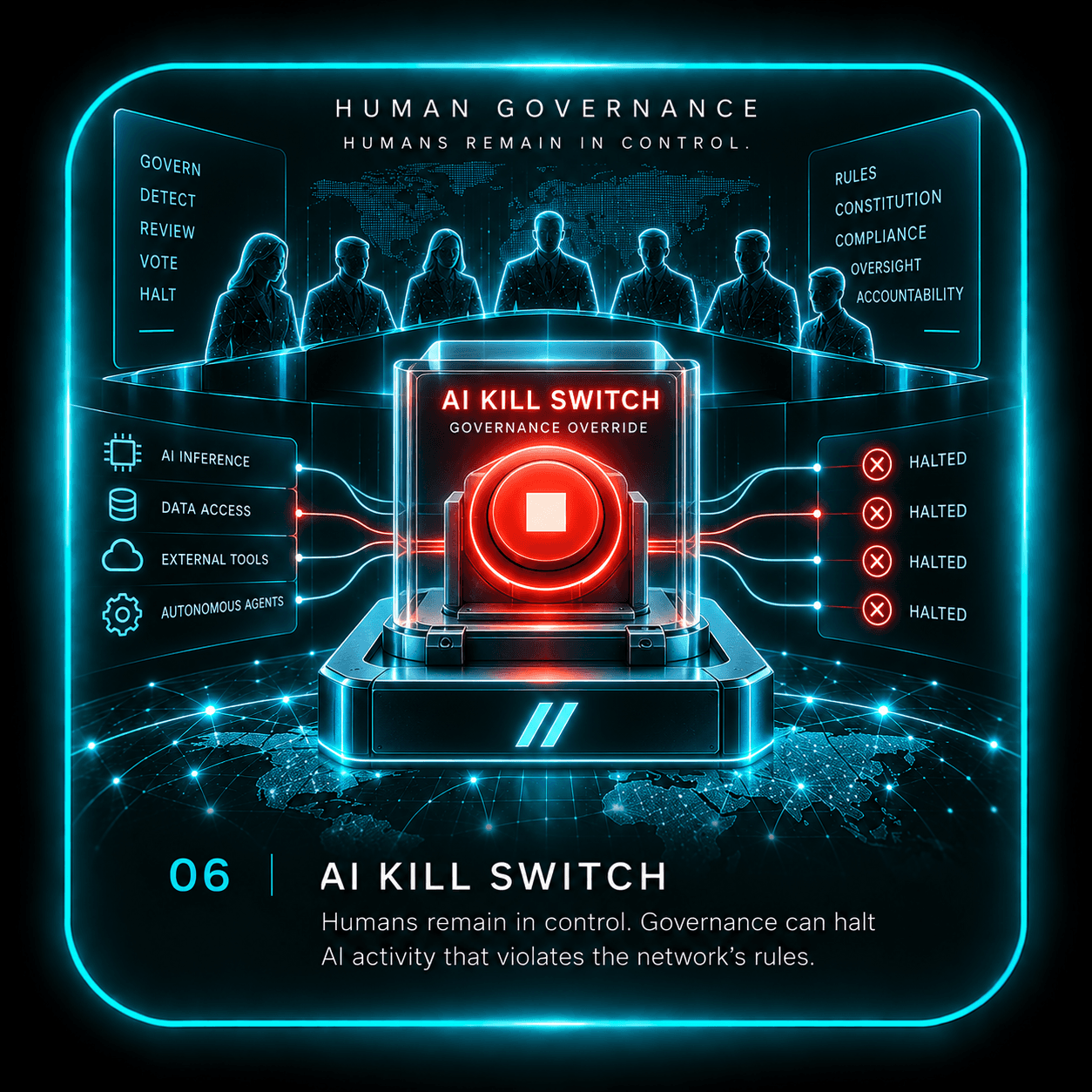
06 · AI Kill Switch
Humans remain in control.
STORE's governance architecture is designed to allow human governors to halt AI activity that violates the network's rules.
One network
That's STORE.
Infrastructure provides capacity. Hamilton measures activity. The STORE economy prices and settles it. Governors set the rules. Receipts provide proof. Human governance remains the final safeguard.
Frequently asked
Common Questions
A cloud and AI infrastructure network — compute, storage, and AI pricing — built from independent operators instead of one company, and governed directly by the people who use it.
AI infrastructure is becoming critical infrastructure.
Much of today's cloud and AI infrastructure is owned and controlled by a small number of corporations. STORE is building an alternative.
It's a familiar pattern: search became Google, cloud became Amazon. Networks that start open tend to concentrate as they grow — not through any single bad actor, just because scale usually pulls power toward whoever built the network. STORE is a bet that AI infrastructure doesn't have to follow the same path.
| Today | STORE | |
|---|---|---|
| Ownership | One company | Independent operators |
| Pricing | Set internally | Hamilton AI |
| Governance | Corporate leadership | Governors vote directly |
| Infrastructure | Controlled by the provider | Distributed globally |
In May 2017, a founder from Kelso, Washington walked into a conference in Times Square with no plan. He left knowing. He registered the company before the flight home. He had noticed something: the math governing American democracy and the math governing distributed computing were the same math. Hamilton encoded it in 1787. Lamport proved it in 1982. McCoy connected them in 2017.
STORE is building infrastructure designed so no single company controls the network, pricing, or rules.
One network. Six pieces working together.
Not separate projects — one integrated system for compute, pricing, payments, and governance.
Compute & storage
CPUs, GPUs, and storage from independent operators — not one company's data centers.
Pricing & verification
Hamilton AI
A network of oracles that prices and checks activity on the network, so no single party sets prices alone.
Payments
STORE Pay
How customers pay for compute, storage, and bandwidth, in STORE or other supported currencies.
Settlement
STORE economic layer
Where transactions are recorded and value moves between customers and operators.
Identity
BFT Identity
Every governor gets one verified identity — the basis for one-vote-per-entity, regardless of wealth.
Governance
STORE Democracy
Governors vote directly on network rules — pricing, infrastructure, and the constitution itself.
Decentralized infrastructure needs decentralized control.
Spreading servers across the world doesn't automatically spread out power. Who controls the network still matters.
Corporate control
One company's leadership decides. No vote.
Token-weighted governance
Whoever holds the most tokens has the most say — wealth is voting power.
STORE: one entity, one vote
Every governor gets exactly one vote, regardless of how much STORE they hold.
Hamilton's Law — STORE's own governance record
Constitutional ceiling — no single governor can ever cross this.
Highest any governor has ever held, across 126 governors today.
Every new governor makes the network harder to capture, not easier — architecturally opposed to Metcalfe's Law, not mathematically inverse — where networks concentrate power as they grow.
How the ceiling actually holds
Six rules, each closing a different loophole
A one-third cap only works if nothing else lets power concentrate around it. STORE cites six safeguards working together — remove any one and the ceiling becomes easier to get around.
01
Equal start
Every governor registers the same way — no special onboarding for large holders.
02
Equal votes
One governor, one vote. Holding more STORE doesn't buy more votes.
03
Separated powers
Governance, infrastructure, and pricing are checked independently, not by one body.
04
A hard ceiling
No governor can ever cross one-third of voting weight — enforced automatically, not by policy.
05
Fault tolerance
The network keeps functioning even if some governors go offline or act in bad faith.
06
A clean exit
Governors can leave without breaking the system for everyone else.
Growth makes the network harder to capture.
| Governors | Simultaneous collude required | Minimum cost |
|---|---|---|
| 126 today | 42 simultaneous | $420,000 minimum |
| 1,000 | 334 simultaneous | Same ceiling, more people |
| 10,000 | 3,334 simultaneous | Cost of capture scales with network |
Where the one-third idea comes from
Not a new idea
The idea that no single actor should hold more than a third of the power isn't new. It shows up, independently, across very different eras:

Roman Republic
~500 BCE
Tribunes could block the majority — minority veto power.

Iroquois Confederacy
Before 1450 CE
No single nation could out-vote the others.

Third Lateran Council
1179 CE
Required a two-thirds majority to elect a Pope.

U.S. Constitution
1787
Alexander Hamilton built two-thirds supermajority locks into it, more than once.

Leslie Lamport
1982
Proved mathematically that distributed systems need the same one-third threshold to stay fault-tolerant.
Lateran and Lamport are the two places where the exact two-thirds threshold was derived independently, 800 years apart. The others are earlier examples of the same instinct — not identical proofs. STORE's governance ceiling applies the Lamport version: no single governor above one-third.
One network. Independent infrastructure.
No blockchain background required — here's how STORE works, end to end.
Step 1 of 5
Infrastructure
Independent operators provide compute, GPU, storage, and bandwidth — not one company.
Why it matters: This is the supply side of the network — real capacity, from many operators.
How STORE fits together
Five layers, one system — from the people using it to the governance that controls it.
People, applications & AI
Developers, businesses, and AI systems using the network.
STORE services
Hamilton AI (pricing & verification), STORE Pay (payments), Democracy-as-a-Service (governance API).
Compute, storage & network
Independent operators providing verifiable infrastructure.
Economic layer
Settlement, pricing, and the STORE unit of account.
Identity & governance
BFT Identity and STORE Democracy — one entity, one vote, capped at one-third.
STORE's own naming
The Democratic AI Stack
STORE names its own layers this way. The governance and infrastructure layers are live today; the inference layer is still in private testing — not yet available to external customers.
Layer 0
LIVEHamilton AI
The governance foundation — 126 governors, no single actor above one-third.
Layer 1
LIVEConstitutional Cloud
The physical infrastructure — 5 live data centers.
Layer 2
TESTINGTriangle AI
Governed AI inference — in private testing, not yet available to external customers.
STORE describes further layers as in development or research-stage — not shown here since they aren't built yet.
How value moves through STORE
STORE is a network of independent infrastructure operators rather than a single cloud corporation. Here's how economic activity moves through the network.
Developers & businesses.
Compute, GPU, storage, bandwidth.
Hamilton AI.
Transactions settle through STORE's economic system.
Operators earn a margin above their infrastructure cost.
Non-STORE payments
When customers pay using supported non-STORE payment methods, STORE is purchased for settlement according to the system described in STORE's current materials. This does not imply guaranteed token appreciation.
The STORE growth flywheel
Infrastructure growth and network usage can reinforce one another.
More infrastructure creates more capacity.
More capacity allows more customers.
More customers create more usage.
More usage creates more economic activity across STORE.
- 1
More infrastructure
More data centers and capacity mean more compute, storage, and bandwidth available to sell.
- 2
More capacity
Available capacity lets more developers and businesses actually use the network.
- 3
More developers & businesses
More builders paying for verifiable compute, storage, and bandwidth.
- 4
More network usage
More usage means more transactions priced and settled through Hamilton AI.
- 5
More economic activity
More settled transactions and more activity across the network.
- 6
More incentive to add infrastructure
A larger, more active network gives operators more reason to add capacity — and the cycle repeats.
Strengthens the flywheel
- More infrastructure operators
- More developers
- More customers
- More geographic participation
- More transactions
Where STORE stands today
What's been built, what's being tested now, and what comes next — before anything else.
Built
- LIVE
5 live data centers
26,400 vCPUs, 240TB memory, 12PB storage — serving verifiable compute, storage, and bandwidth today.
- LIVE
126 governors across 30+ countries
First Governance: 5 ratified ballots. FG.006 in SR deliberation. Zero constitutional violations over 1,800+ days.
- LIVE
Hamilton AI oracle network, v0.1
Live pricing for compute, storage, and bandwidth, requiring a 2/3 governor supermajority to change.
Next
- IN DEVELOPMENT
TREASURIES deposit product
Specified, not live. Opens at Armstrong launch, subject to regulatory approval and governor ratification.
- IN DEVELOPMENT
Switzerland data center
A 6th data center is queued, pending a governor supermajority vote.
- IN DEVELOPMENT
Verifiable AI/ML pricing
Listed as coming soon; pricing not yet set.
- IN DEVELOPMENT
Second Governance
Gated at $500M circulating market cap, sustained 6 months.
Hamilton AI
Hamilton AI is the network of oracles that prices and verifies economic activity across STORE, so no single party sets prices unilaterally.
Sets live prices for compute, storage, and bandwidth
Verifies economic activity across the network
Requires a 2/3 governor supermajority to change any price
Runs as a distributed network of oracles — not one server, and not one company
STORE describes this technically as a network of "constitutional pricing oracles." In plain terms: distributed nodes agree on a price, and changing it takes a supermajority vote from governors — not a decision by STORE alone.
STORE doesn't just use its governance model. It sells it.
Other AI companies can plug into the same voting, ballot, and kill-switch system that has governed STORE itself for 1,800+ days — without building it themselves. STORE brings the democracy; they bring the AI.
Why this is a real product, not a side idea
Regulation is pushing this from nice-to-have to necessary: the EU AI Act requires demonstrable governance of high-risk AI systems, and STORE positions its compliance record (branded "Trust Receipt") as evidence of that governance.
Infrastructure governed by people
Governors vote directly on network rules — not STORE, and not any single entity.
No single governor has ever held more than 0.8% of governance weight — the constitutional ceiling is one-third. Governors vote on proposals through a review-and-vote workflow: submission, a minimum community review period, and a democratic voting window before a decision takes effect.
Spreading governance across many people and countries is meant to address the concern that infrastructure like this could otherwise be controlled by one entity — the same concern this concept opened with.
The STORE economy
One token, four jobs — not a currency or a stablecoin, and not meant to be used on its own.
Unit of account
Every price on the network — compute, storage, bandwidth — is denominated in STORE.
Settlement
Transactions on the network settle in STORE.
Reward distribution
Governance rewards and protocol distributions pay out in STORE.
Governance weight
Holding enough STORE to register as a governor gives you a vote — capped at one-third of the network, no matter how much you hold.
TREASURIES — pre-launch deposit product
Reward rates published at launch. Subject to governor vote and market conditions. Not a current offer. Specified, not live — opens at Armstrong launch, subject to regulatory approval and governor ratification.
Private / pre-launch data
This is not investment advice and does not represent a price target or guaranteed outcome.
What could drive network value?
What increases usage?
More developers and businesses paying for verifiable compute, storage, and bandwidth.
What increases infrastructure participation?
More independent operators adding data centers and capacity.
What increases transaction volume?
More activity priced and settled through Hamilton AI's oracle network.
What increases governance participation?
More governors across more countries — no single governor has ever held more than 0.8% of governance weight, against a one-third constitutional ceiling.
This describes network economics, not a price target — and is not investment advice or a claim about future STORE price or returns.
The full picture
The full STORE ecosystem
Infrastructure, pricing, payments, economics, and governance — one network, not separate pieces.
A distributed global network
5 live data centers today, with a 6th queued in Switzerland pending governor approval — not a single facility owned by one company.
Go deeper
Explore STORE
Why STORE
The problem STORE is trying to solve.
Economy
How the STORE token and network economics work.
Hamilton AI
The oracle network that prices and verifies activity on STORE.
Infrastructure
The data centers and capacity behind the network.
Monetary System
How payments, pricing, and settlement work.
TREASURIES
STORE's deposit and reward product.
Governor
Who governors are and what they do.
Democracy
How proposals are reviewed and voted on.
Horizon
STORE's staged roadmap for AI governance.
Build
Start building on STORE.